The Drying Ledger: A Renovation Programme Built on Curing, Humidity and the British Year

Photo: All rights reserved, Alex Whitlock, 2013-11-11 17:05:43, CC BY-SA 4.0, via Wikimedia Commons
The Programme Is a Physical Document
A renovation programme is usually presented as a timetable of trades: first fix, plaster, second fix, decoration, handover. That is a useful summary, but it is not the whole document. Between those labels sit physical processes that cannot be compressed indefinitely. Plaster must lose moisture. Screed must gain strength. Render must weather without being asked to do too much too soon. Paint must adhere to a surface that is ready for it, not merely one that looks dry. Joinery must settle into the room it will inhabit.
The calendar, in other words, is not a neutral container for the work. It is one of the materials. In a UK renovation, it is a material supplied by the weather, the heating regime, the ventilation strategy and the occupancy of the house. A programme that ignores this will not necessarily fail on the day the work is signed off. It may fail months later, in the form of hairline cracks, swollen doors, blistering paint or a floor that sounds hollow underfoot. The purpose of a drying ledger is to make those physical dependencies visible before they become disputes.
Why British Weather Complicates the Sequence
UK construction does not face a single climatic problem. It faces a moving target. A warm, dry week in late spring can flatter a programme; a damp October can expose assumptions that were never tested. Relative humidity matters as much as temperature. A room may feel warm while its surfaces remain cool enough for condensation to form, particularly where new plaster or screed is releasing moisture into still air. Wind-driven rain can delay external render, but so can a spell of cool, humid weather that leaves the substrate unable to dry between coats.
The practical consequence is that the programme should distinguish between work that is weather-exposed and work that is protected. External render, masonry repairs and some roof works belong to the former. Internal plaster, screed and decoration belong to the latter, but they are not immune to the season. If the building is not yet watertight, or if temporary heating is being used to force progress, the internal sequence may be borrowing time from the finish.
Plaster: Dry Enough Is Not the Same as Cured Enough
Plaster is often judged by appearance. A wall can look pale and firm while still holding significant moisture. The risk is not only that decoration will trap that moisture; it is that the plaster itself has not developed the conditions in which it can perform. Background suction, surface temperature and air movement all influence how quickly moisture leaves the wall. In a sealed room with no ventilation, the moisture has nowhere to go. In a room heated aggressively, the surface may dry too quickly while the deeper material remains damp.
The programme should allow for a measured drying period, with ventilation and, where appropriate, controlled dehumidification. The exact duration depends on the plaster type, substrate, thickness and conditions, so it is better to specify the checks than to pretend a fixed number of days will always suffice. A moisture meter, a record of readings and a decision point before mist coats or decoration are more useful than an optimistic date in a spreadsheet.
Screed and Render: Strength Gained Over Time
Screed is a good example of a material that is often asked to hurry. It may be walked on before it is ready, covered before it has dried, or heated before it has cured. Each of these decisions can affect the floor finish above it. The programme should identify when the screed is ready for foot traffic, when it is ready for a moisture-sensitive covering, and when any underfloor heating can be commissioned. Those are separate milestones, not a single event.
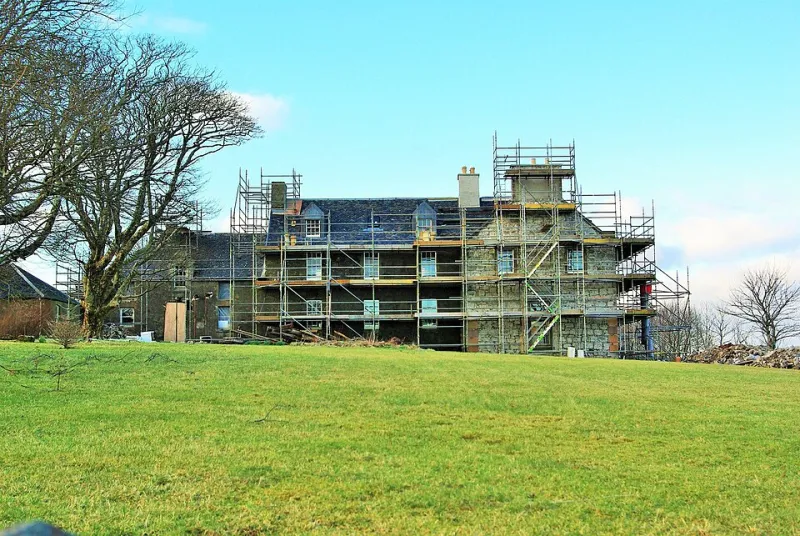
Render has a similar logic on the outside. It needs protection from rapid drying and from frost, and it needs time between coats. In a British autumn, the gap between coats may be longer than the programme assumes. If scaffolding is due to come down for a handover photograph, there is a temptation to compress the render sequence. That is precisely the point at which the finish should be defended, because external render failures are expensive to correct and difficult to explain to a homeowner who was told the work was complete.
Paint and Joinery: The Room Has to Be Ready
Decoration is frequently scheduled as the last trade before handover, which makes it the first place where time pressure becomes visible. Paint applied to a damp substrate may look acceptable for a few weeks, but it can subsequently blister, flake or trap moisture. The programme should include a decoration readiness check: substrate moisture, surface temperature, dust levels and ventilation. These checks are not administrative extras. They are the difference between a finish that lasts and one that is merely photographed.
Joinery has its own timetable. Timber is hygroscopic; it responds to the moisture content of the room. Doors, skirting and fitted furniture should be allowed to acclimatise before installation, and the room should be at a representative humidity before final adjustments are made. If a newly plastered room is still drying while oak doors are hung, the doors may swell or bind as conditions change. A small allowance in the programme for acclimatisation and a return visit for adjustment is often more valuable than a rushed final fix.
Heating, Ventilation and the Difference Between Warmth and Dryness
Temporary heating is often treated as a solution to slow drying. It is only part of the solution. Warm air can hold more moisture, but unless that moisture is removed by ventilation or dehumidification, it remains in the building. In some cases, heating a damp room without air exchange simply moves moisture around and raises the risk of condensation on cooler surfaces.
The programme should therefore name the drying strategy, not just the heating appliance. Which rooms will be ventilated, when, and by what method? Will dehumidifiers be run continuously or in cycles? How will temporary openings be secured and weatherproofed? Who is responsible for checking conditions over a weekend or a cold snap? These questions belong in the pre-start plan because they affect the sequence of trades, the decoration date and the handover date.
Protecting the Finish When Dates Are Fixed
Fixed dates are a reality of renovation. Homeowners have moving dates, tenants have notice periods and businesses have opening days. The useful response is not to deny the physics but to create decision points. If a room is not dry enough for decoration, the programme should have a fallback: delay that room, protect the partially completed work and reorganise the trades around it. A phased handover may be preferable to a compromised finish.
The drying ledger is a simple instrument: a room-by-room record of what has been installed, what it needs before the next stage, and what evidence confirms readiness. It does not need to be elaborate. It needs to be honest. When the British year presses against the programme, that record is what allows a contractor to explain a delay in terms of the building rather than in terms of excuses. It is also what allows a homeowner to trust that the finish has been given the time it needs.